The Pump and Funnel Marketing Model: A Marketing Model Born For the Ages
The Pump and Funnel Marketing Model was developed by David Bain, following his first digital marketing training session in 2007. Over the intervening years, it has evolved into a comprehensive framework designed to help professional marketers bring together every disparate marketing activity into a single, coherent strategy. Rather than treating individual campaigns, channels and tactics as separate endeavours, the model provides a unified structure within which everything connects and compounds.
Starting With the Standard Funnel
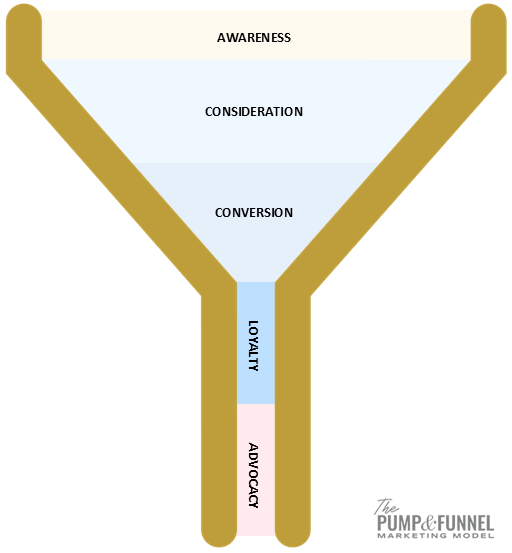
Most marketers are familiar with the traditional awareness, consideration, conversion, loyalty and advocacy funnel (Fig. 1). It serves as a useful starting point for understanding where customers sit in relation to their likelihood of making a purchase. However, the standard funnel does not fully represent the opportunity available to marketers, nor does it reflect how customers actually move through their relationship with a business over time.
Evolving into the Pump and Funnel Marketing Model
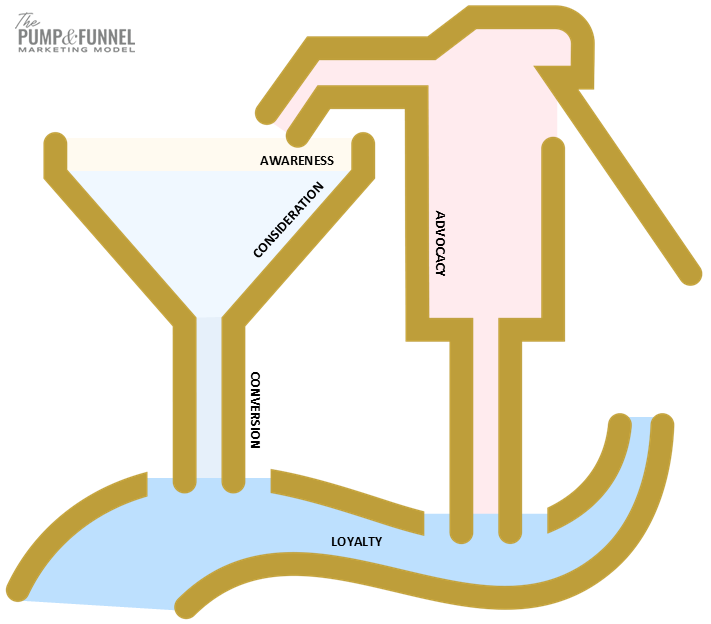
The Pump and Funnel Marketing Model retains those five core stages — awareness, consideration, conversion, loyalty and advocacy — but rearranges them to introduce two important additions: the lake of loyalty at the base of the model, and the pump mechanism, which actively circulates advocacy back into awareness (Fig. 2). This reflects the reality that satisfied customers are one of the most powerful drivers of new business, and that no model is complete without accounting for this cycle.
Applying the 3H Content Framework
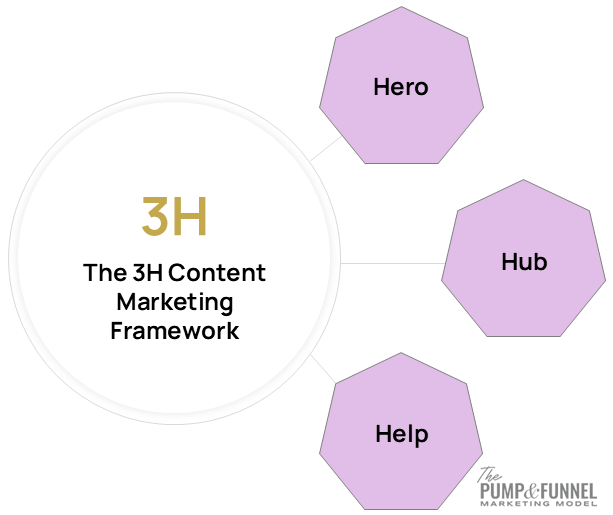
Once the structure of the funnel was established, the next question was how potential customers become aware of a business in the first place. The answer, of course, is content — published across both online and offline channels. This led to the application of the 3H Content Marketing Framework (Fig. 3), originally developed by Google and YouTube, which categorises content into three types: Hero, Hub and Help.
Within the Pump and Funnel model, each of these content types maps to a specific stage of the customer journey:
- Hero content — books, films, pillar blog posts and other landmark pieces — maps to the awareness stage at the top of the funnel. These are the bold, attention-commanding pieces designed to reach the widest possible audience.
- Help content — long-tail query blog posts, keyword-focused articles and, increasingly, content optimised for AI search — maps to the consideration stage. These pieces answer specific questions that prospects are actively searching for.
- Hub content — podcasts, YouTube shows and regular series — sits outside the funnel itself. It serves the audience who are not yet ready to buy but who benefit from consistent, trust-building content over time.
This distinction is particularly important (Fig. 4). Hub content functions as a long-game investment in relationship-building. In a long sales cycle, it is often the consistent presence of a podcast or YouTube series that keeps a brand front of mind whilst a prospect is deciding.
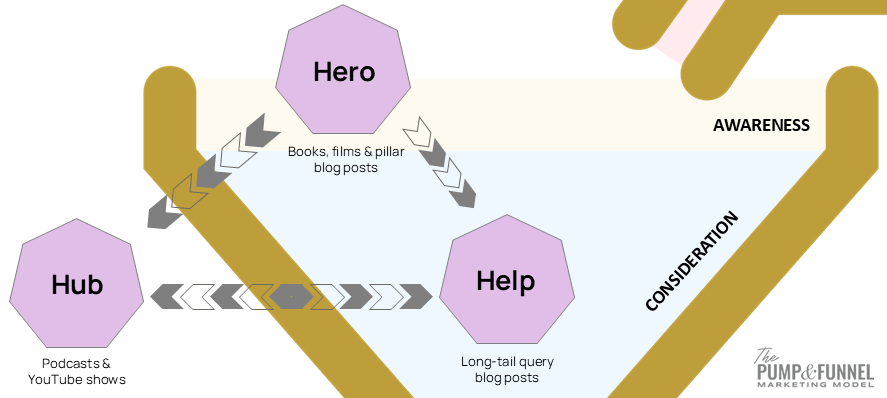
The placement of Hub content outside the funnel is one of the most distinctive and counterintuitive aspects of the Pump and Funnel model. Most marketers instinctively try to map every piece of content to a conversion goal. Hub content resists this. Its value is cumulative — each episode, each video, each newsletter compounds the relationship with an audience that is not yet ready to act but will be in time.
The practical implication is significant: Hub content should be measured differently from funnel content. Subscriber growth, episode downloads, watch time and return listener rates are the metrics that matter — not conversion rates or cost per lead.
Extending the Model: The 6H Framework
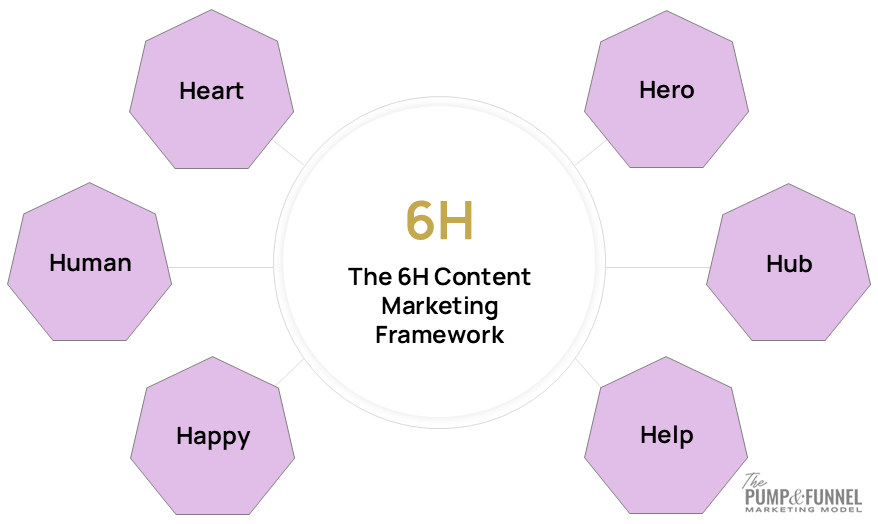
The natural progression from mapping the 3H framework to the top of the funnel was to ask: what types of content serve the lower stages? This led to the development of an extended 6H Content Marketing Framework (Fig. 5), adding three further content types — Heart, Human and Happy — to complete the picture.
These map to the conversion, loyalty and advocacy stages respectively:
- Heart content maps to conversion. This is product-focused, sales-oriented content — compelling sales pages, detailed product descriptions and conversion copy that makes a clear, persuasive case for why a customer should act now.
- Happy content maps to loyalty. Once a customer has made a purchase, Happy content — welcome sequences, onboarding videos, confidence-building email series — helps transform a tentative buyer into a genuinely satisfied, loyal customer.
- Human content maps to advocacy. More personal, human interaction — whether through community, direct engagement or personalised outreach — is what turns a loyal customer into a genuine brand advocate who recommends the business to others.
The addition of these three content types addresses a gap that many marketers recognise but rarely name: the absence of a deliberate strategy for the stages that come after conversion. Most marketing frameworks focus heavily on acquisition and give comparatively little attention to loyalty and advocacy. The 6H framework corrects this imbalance.
Happy content in particular is frequently overlooked. The period immediately after a purchase is one of the most psychologically sensitive moments in the customer relationship. A new customer who feels supported, informed and confident in their decision is far more likely to remain loyal, spend more and recommend others. A new customer left to figure things out alone is far more likely to experience buyer's remorse.
Connecting Content to Marketing Channels
The 6H content types do not operate in isolation — each one is activated and amplified through specific marketing channels, as illustrated in Fig. 6. Understanding which channels best serve each content type is central to implementing the Pump and Funnel model effectively:
- Hero content is extended through partnerships — co-created content, guest appearances and cross-promotional activity that places landmark pieces in front of new audiences.
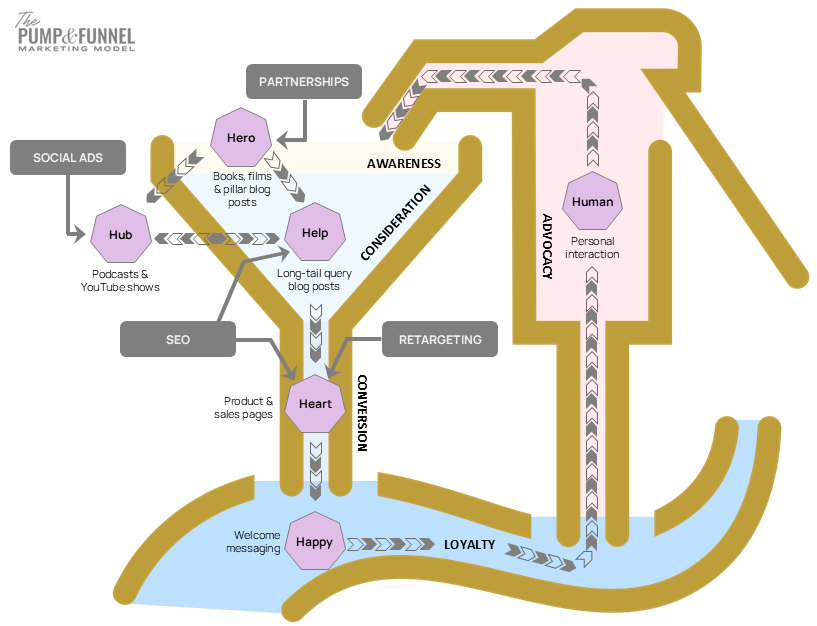
- Hub content is grown through social advertising — repurposing podcast episodes and YouTube content into short-form social ads that drive new subscribers into the hub.
- Help content is amplified through SEO — ensuring that long-tail, question-based content is discoverable both in traditional search and in AI-powered search results.
- Heart content benefits from retargeting — paid advertising that re-engages warm prospects who have already demonstrated interest but have not yet converted.
Together, these channel strategies ensure that content does not simply exist, but actively reaches the right people at the right stage of the funnel — creating a unified, self-reinforcing marketing system.
What makes this channel mapping so powerful is the discipline it imposes. Without it, marketing budgets tend to flow towards the most measurable activities — typically paid acquisition and retargeting — whilst the harder-to-measure but equally important activities at the top and outside the funnel (Hero and Hub) are underfunded. The Pump and Funnel model makes the case for investing across all six content types, not just the ones with the clearest short-term return.
For professional marketers managing multiple channels simultaneously, this mapping also provides a useful audit tool. By reviewing their current channel mix against the 6H framework, they can quickly identify which stages of the customer journey are being served well and which are being neglected — and make resourcing decisions accordingly.
The Pump and Funnel Marketing Model was developed by David Bain, content marketing strategist and host of the Pump and Funnel Marketing Show.
Key Terms in the Pump & Funnel Marketing Model
- The Pump
- The mechanism within the Pump and Funnel Marketing Model that drives advocacy from existing customers back into awareness, actively generating new demand. The pump represents the compounding power of satisfied customers recommending a business to others.
- The Lake of Loyalty
- The reservoir at the base of the Pump and Funnel model where loyal customers accumulate. Rather than a linear exit point, the lake of loyalty represents an ongoing pool of brand advocates whose energy feeds back into the top of the funnel via the pump.
- The 6H Content Marketing Framework
- An extension of the original 3H framework (Hero, Hub, Help) developed by Google and YouTube. The 6H framework adds Heart, Human and Happy content to map all six content types across every stage of the customer journey — from initial awareness through to advocacy.
- Hero Content
- High-impact, landmark content — such as books, films and pillar blog posts — designed to reach the broadest possible audience. In the Pump and Funnel model, Hero content maps to the Awareness stage.
- Hub Content
- Regular, episodic content — such as podcasts and YouTube series — that sits outside the funnel. Hub content nurtures audiences who are not yet ready to buy, building trust and familiarity over a longer period.
- Help Content
- Question-answering content — long-tail blog posts, keyword-focused articles and AI-search-optimised content — that maps to the Consideration stage. Help content reaches prospects who are actively researching a solution.
- Heart Content
- Sales and product-focused content — compelling sales pages and conversion copy — that maps to the Conversion stage of the funnel, making the case for why a prospect should act now.
- Happy Content
- Onboarding and welcome content — sequences, videos and messaging — that maps to the Loyalty stage. Happy content transforms a new customer into a confident, satisfied one.
- Human Content
- Personal, direct interaction — community engagement, personalised outreach and human touchpoints — that maps to the Advocacy stage, turning loyal customers into active brand advocates.
How to Implement the Pump and Funnel Marketing Model in Seven Easy Steps
The following steps outline how professional marketers can begin applying the Pump and Funnel Marketing Model to their existing activities, bringing every disparate channel and tactic into a single unified strategy.
Audit your existing content against the 6H framework
Review everything you currently produce and assign each piece to one of the six content types — Hero, Hub, Help, Heart, Happy or Human. This audit will immediately reveal which stages of the funnel are well-served and which have gaps.
Identify your Hub content vehicle
Decide which format — podcast, YouTube series or regular newsletter — will serve as your Hub. This is the long-game, relationship-building channel that sits outside the funnel and nurtures prospects over time. It does not need to be elaborate; consistency matters far more than production value.
Create or strengthen your Hero content
Identify the one landmark piece of content that best represents your expertise and reach. This could be a comprehensive guide, a definitive research report or a flagship video. Hero content is the piece you build partnerships around and use to reach new audiences at scale.
Build out your Help content for search and AI discovery
Map the questions your ideal customers are asking at the consideration stage and create dedicated, well-structured content to answer each one. Optimise for both traditional search and AI-powered search engines, which increasingly draw on clearly written, authoritative content to generate answers.
Develop Heart, Happy and Human content for the lower funnel
Ensure that conversion, loyalty and advocacy are not left to chance. Invest in a compelling sales page (Heart), a thoughtful onboarding sequence (Happy) and genuine human engagement touchpoints (Human). These are the stages most often neglected, yet they directly determine whether customers stay, spend more and recommend others.
Activate the Pump — turn awareness into advocacy
Build deliberate mechanisms for turning satisfied customers into advocates — referral programmes, case studies, testimonials and community spaces. These are the inputs that power the pump and drive new awareness without additional paid spend.
Map your marketing channels to each content type
Assign a primary distribution channel to each of the six content types: partnerships for Hero, social ads for Hub, SEO for Help, retargeting for Heart. Review this mapping quarterly and adjust as channels evolve — particularly as AI search continues to reshape how Help content is discovered.
Stay ahead of the model as it evolves.
Download the free Pump and Funnel Marketing Model Quick-Start Guide and receive updates whenever new content, episodes and framework developments are published. Everything you need to keep your marketing unified and current.